
Active Vibration Control of Smart Constrained Layer Damping (SCLD) Structure
vibration and noise · smart constrained layer damping · SCLD · ADF model · adaptive control · dynamic neural network identification
Overview
This case targets a Smart Constrained Layer Damping (SCLD) structure. A dynamic model is established and piezoelectric materials are used for active control. Considering system nonlinearity, time-variation, and uncertainty, an adaptive controller is designed to improve vibration response performance. Acoustic radiation characteristics are analyzed based on the vibration model, providing new approaches for interior vibration and noise control in enclosed cavities such as automobiles, aircraft, and submarines. ---
System Architecture
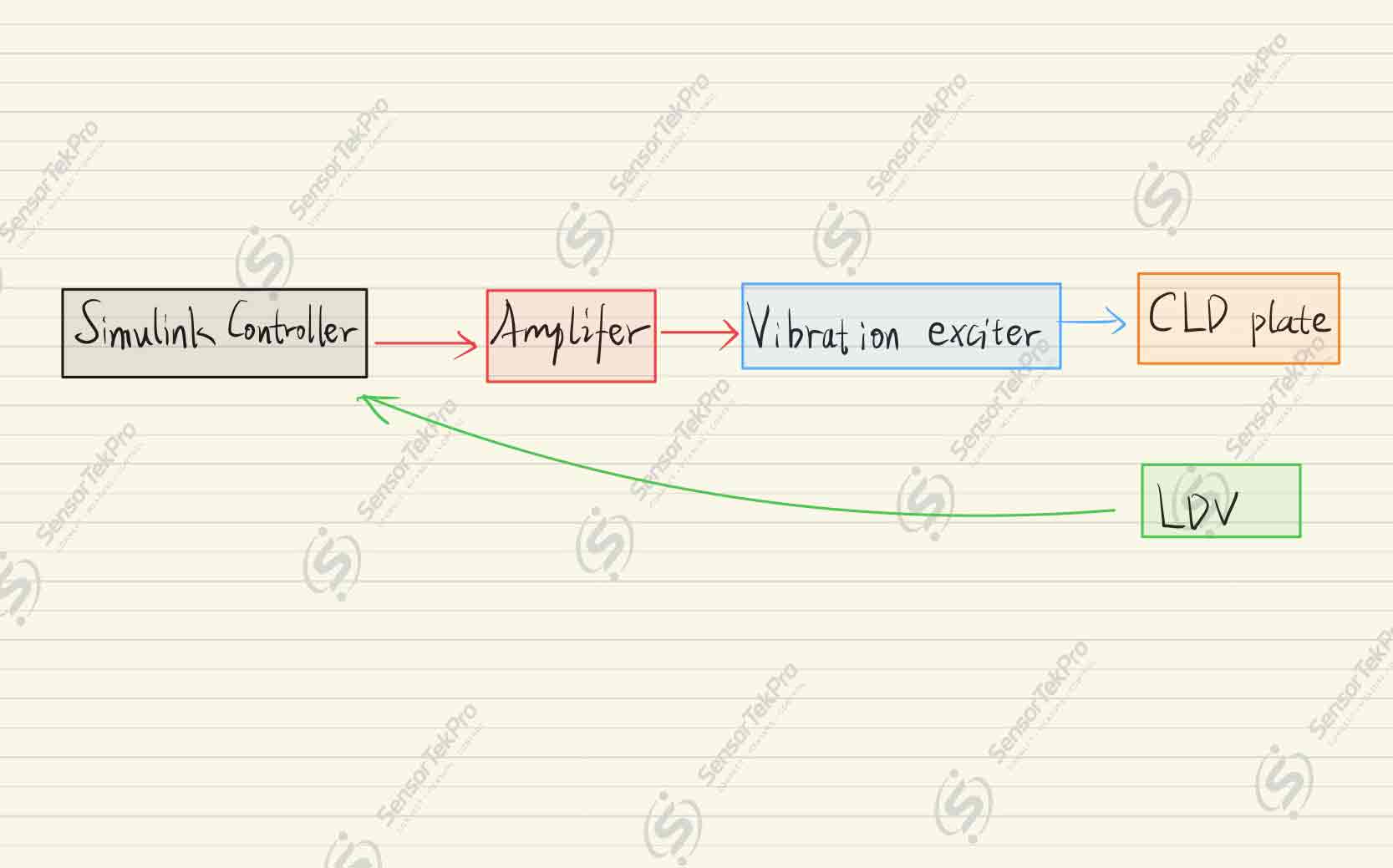
Signal flow summary: 1. **Controller** outputs signal to the external disturbance exciter. 2. **External disturbance exciter** applies the signal to the plate structure, generating disturbance vibration. 3. **Power amplifier** amplifies the control signal and drives the SCLD plate structure. 4. **Laser vibrometer** measures the vibration response of the SCLD plate structure.
Experimental Setup
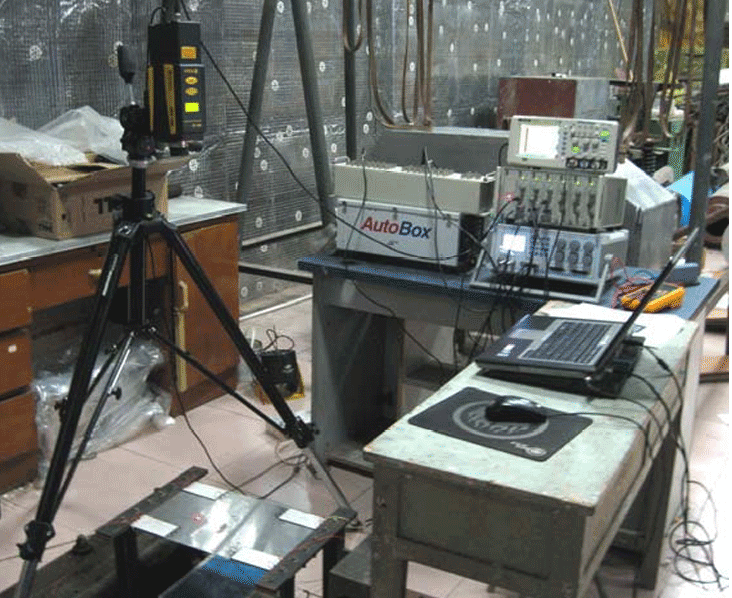
Hardware Configuration
| Component | Model |
|---|---|
| Electromagnetic Shaker | B&K 4825 |
| Power Amplifier | B&K 2716 |
| Non-Contact Laser Vibrometer | Polytec PDV-100 |
Platform Compatibility Note
This system was validated under QUARC / Simulink. The signal interfaces (analog voltage, encoder, digital I/O) are electrically compatible with real-time control platforms including dSPACE, Speedgoat, and NI systems.
Applicable Scenarios
- Graduate research: active noise and vibration control thesis experiments
- Automotive / aerospace: interior acoustic noise reduction using smart materials
- HIL simulation: adaptive controller validation on real structural systems
- Control course labs: SCLD structure modeling and active damping control
Important Notice
This application example documents an actual lab setup and is provided for technical reference only. Hardware shown reflects the validated configuration used in this experiment; equivalent substitutions may be applicable for similar setups. Customers are responsible for final product selection and application suitability assessment.